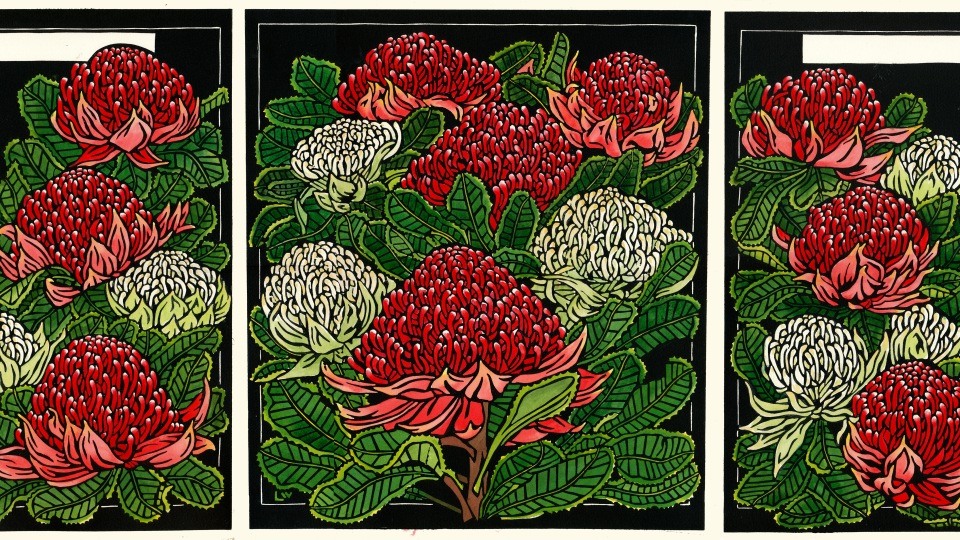
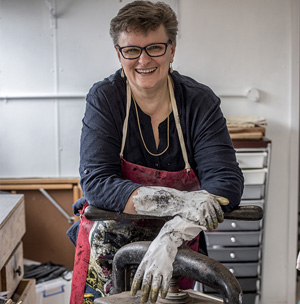
Tutorials – Art Bytes from Lynette Weir’s Studio Practice

LYNETTE WEIR – PERMISSION FOR USE OF ARTWORK

Linocuts, design, drawing & illustrations by Australian Artist – Lynette Weir

These ‘tutorials’ are an insight into the working methods of Australian Artist – Lynette Weir.

All images, tutorial content on this site unless specified otherwise, are copyright to Lynette Weir and cannot be used without permission.

This tutorial site is a compilation of posts I have made to my Studio Diary – Soulsong Art. They are not a definitive way of producing a linocut or drawing. They are simply a guide based around my own working methods.

I have posted the tutorials here in an order that hopefully will make it easier for you to find information about linocuts or drawing.

Although a largely static site I will be posting additional tutorials and updates from time to time.

So if you want to keep up with these updates please follow this blog or any of my other links – SoulsongSoulsong Art, Lynette Weir

The linocut tutorials here are based on my own working methods. Artists/printmakers all work differently – some may work in a similar way to myself and others completely different. So the tutorials contained here should be seen within this context and as a guide to working or just as an example how one artist works.

All information is a guide only and is based on Lynette Weir’s own arts practice with Linocuts and Drawing – individuals should take their own due care in working with these and other artistic endeavours and mediums.

I would encourage everyone to take a look at how I work but develop your own style and way of working.

Copyright – Lynette Weir

, , , , ,

Leave a Comment

Developing your own voice as an artist… my personal journey…
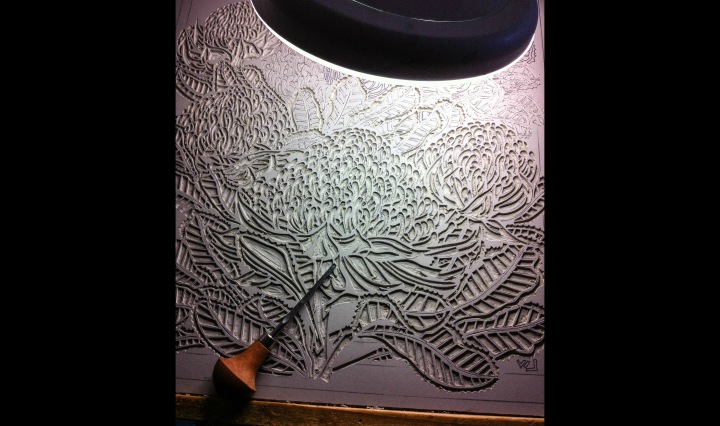
I grew up in Sydney surrounded by the Australian bush – the Royal National Park and those amazing displays of the sandstone Australian flora that Sydney seems to be steeped in. Even the buildings in Sydney reflect the legacy of all this sandstone.

I loved the bush – disappearing either by myself or with others and exploring the caves, bush tracks and creeks. Surrounded by blandly named streets – First Avenue, Second Avenue right up to Tenth Avenue, National Avenue…but I grew up in Primrose Place.

Primrose Place was a cul-de-sac nestled in amongst all these streets going somewhere – an enclosed street and neighbourhood community with a hill for billy cart racing, bike riding, skateboarding and roller skating with the other kids from this street, some of whom are still my friends.

Our house started out as a small 2 bedroom one bathroom fibro place right down the bottom, round the corner of the hill at the bottom end of the cul-de-sac.

I loved this street, the neighbourhood, the other kids in the street to play with, but central to it all was the closeness of the bush – exploring the sandstone caves, running away from snakes, abseiling with ropes we found in the shed (with no safety gear), the bushfires, and of course the wildflowers and wildlife. To this day I love the blush of pink and red new leaf growth of the eucalypts, the towering Gymea lily flower stalks and the absolute thrill of finding wild waratahs, banksias and flannel flowers.

I absolutely loved growing up there and in a time where we could go off as kids and just explore. Most of all I loved climbing trees. The bush is part of who we are and it is no accident to think that it has always remained with my brother who is involved in Bush Regeneration and Land Management and myself as an artist.

I enjoy living where I do now but I miss the ‘wildness’ and familiarity of the Sydney Bush.

Days where we would go down to The Royal National Park sometimes and visit the Audley Boatshed (it’s still there and you can still hire boats).

For a few years after I got married we lived in Helensburgh and had our own little bushland with a yard with no fences and miles of bush beyond.

I spent 4 years at art college training to be an art teacher but I was really there for the art studio times, I found classroom teaching at high schools difficult.

When I finally started developing my own arts practice and linocuts in about 1998, I worked not only with lino and design but I also went out and did drawing classes, calligraphy and watercolour classes. I learned through workshops, classes and my own arts practice how to work with watercolours, papers, calligraphy, drawing, design, photography and lino. I explored how I could blend all of these interests and worked at developing my own style. It always came back to my main passions – drawing, photography and linocuts.

This is an earlier work from 1998 – the black and white waratah images (including the one above) I had taken years before my first inspiration for this linocut.

I deliberately chose to not research or even look at other linocut artists at this time and what they were doing – I knew a little of the historical linocut artists like Margaret Preston and Noel Counihan but again I put all of their images aside. The only thought I had was I was that I was not going to develop work based around the still life of wildflowers in vases.

I took lots of photos, did drawings, explored and played with ideas and media.

It was not until I felt comfortable with my own style and where I was at with developed my own voice to express myself through my artwork years later, that I then allowed myself to have a closer look at what others were doing.

Probably it was around the time when I began to have more access to the internet and more information became available online. Living in the country, raising children and looking after elderly relatives my access to the wider arts community and even traveling to larger cities like Brisbane and Sydney has been limited.

Not everyone works this way but it is just how I have chosen to work and developed my own voice as an artist.

It has not been easy being a linocut artist working with more traditional subject matter as I have done. Galleries have found it difficult to fit my work into their collections. Within a traditional gallery paintings can be seen as ‘fine arts’ and linocuts as ‘crafts’, and within a contemporary gallery my more realistic representations and traditional working methods are not seen as ‘cutting edge’ enough. But I have tried to be true to my own vision of the work I am creating. I like beautiful interesting images and I love the Australian bush – wildflowers, birds and wildlife, so this is the work I try to create. I could have chosen to become more contemporary – have a different voice to fit in with the galleries view but it just wouldn’t be me. So I have continued down this path.

My website and business name is Soulsong – may sound a bit ‘out there’ but it isn’t really – the Australian wildflowers and wildlife I see as part of my soul, I can get lost and never lose my capacity to spend time in and around the bush and Australian wildflowers and wildlife. I never get tired of exploring this subject matter – it is embedded in my soul. My arts practice is my song, it is the way I express myself through my artwork – so quite simply my artwork is my soul’s song – Soulsong.

It has been a difficult path at times over the past 10 years and the busy pro-active arts practice I was developing from 1998 to 2002 had to be wound back until recently when I am again trying to re-establish myself as an artist. I have had children to raise who have needed me to be there and I have been a family carer for them and for my elderly relatives who have had no one else willing to step up and help them. I do not regret a day of any of that time, it was what was needed to be done, and I have many joyful experiences and learned a lot along the way about myself and human nature.

So I would encourage artists whether beginners or further down the track wot work hard at making your own mark with your artwork, love your subject matter and medium and work hard at having your own voice or style of work.

Copyright – Lynette Weir

, , , , , ,

Leave a Comment

LYNETTE WEIR – PERMISSION FOR USE OF ARTWORK

Image Use Inquiries

All inquiries seeking permission for the use of Lynette Weir’s artwork are most welcome.

Lynette’s work is at times available under license for particular projects of a commercial nature.

Lynette supports many non-profit organisations by allowing them permission to use her artwork, but you do still need to seek permission.

Requesting Permission

Lynette Weir requires the disclosure, if applicable, of any affiliations to any other organisations the requesting person may have. Lynette Weir does not want her artwork used to promote organisations that have or have had, links to other organisations with a social/political agenda whose views she does not support.

Any use of Lynette Weir’s artwork by an organisation or individual without her permission should not be seen as supportive of them, nor any views expressed within that organisation.

, , , ,

1 Comment

Art diaries, journals, sketchbooks…where to start…

  I believe it is important in developing your arts practice to use art diaries/journals/sketchbooks/notebooks even online blogs to keep track of your ideas, thoughts, sketches, make notes of things that interest or are important to you as an artist. These are useful to look back on and in developing your own ‘voice’ or style of art or providing technical notes of how to do things. These can also provide valuable back up for you as an artist and establishing copyright of your work.

In trying to represent the idea we have in our mind and then take that idea in our chosen media, we can have feelings that range from frustrating to ecstatic (when it actually works!). By keeping track of these things you can always backtrack and find them. If your filing system is good – mine is average – you could simply keep a catalogue of your sketchbooks and find them instantly!

Many, many times things just do not go well for a variety of reasons and as frustrating or disappointing it may be ‘starting again’, backtracking a little or even discarding the whole idea is also part of the process of creating artworks.

The most important aspect of all of this is the process of learning and developing your arts practice – even if the work is discarded it is important to note ‘why’ and perhaps ‘how’ you’d do it differently – this is the most important aspect!

I was told many times in art college – keep all your drawings so you can see the developments. This becomes impractical but I do actually still have ‘selected’ drawings from that time – just to remind me.

The development of art diaries, journals or sketchbooks are extremely important and are a more ‘contained’ way of keeping track in developing your arts practice – it also gives insights into the thinking and working behind your works. It also gives you the opportunity to document mistakes, the learning and hopefully moving forward in ability.

It was said to me 10 years ago by an experienced and well-known artist that “if you continue in your arts practice, you will look back in 10 years and you will be able to do so much more than you could back then and be able to see your development”. This is just so true! It is clearly illustrated by my HSC major works from 27 years ago…and my more recent initial new work in the field of pen and ink illustration.

These are my old HSC Drawing Major Works from *cough* years ago…(1981). They are a mixture of watercolour pencils, coloured pencil and (rotring) pen and ink. I must say looking back some were more successful than others…and I kind of itch to just ‘fix’ some of them or in the case of the seal – get rid of it!


The illustrations using pen and watercolour washes below were completed around 2009/10 – a definite development and improvement I would hope!!


Processing, thinking, practicing and even making mistakes can at times be even more important than producing the artwork…

Copyright – Lynette Weir

, , , , ,

Leave a Comment

The Art of ‘Creative Art-Thinking’ – designing linocuts

In describing some of the processes I that go through in designing my linocuts I have not talked a lot about the ‘art-thinking’ processes. This is probably because they are often complex and hard to describe.

FRAMEWORKS FOR ARTWORKS

For this piece  and many of my pieces I will often start with the idea of a ‘framework’ – of working within/without of a particular shape – rectangular, square, circle etc. Starting with the framework – drawing up thumbnail sketches of different shapes, sizes, ideas – some people hold their hands up together to create a picture frame to limit their vision and provide a frame to work within for designing the edges of the artwork and what they want in it. It narrows the visual field and helps an artist ‘art-think’ what they are trying to achieve/include within an artwork.

A framework can also be suggested by the actual subject matter. So the first step in working in this way is to consider the subject matter – in this case I look at my extensive file of photographs that I have taken. But for me this process means taking one step back again – it begins with the plant/flower ‘in the flesh’.

SOURCE MATERIAL AND ‘CREATIVE ART-THINKING’

I take the photos I work from, so for me my designing starts with ‘seeing’ and photographing, for me a lifelong interest and passion of seeing and representing through taking photographs and filing and preserving family photographs. So in the case of the above design I look at the plant and take numerous photos (thank goodness for digital it is a lot less expensive these days).

The designing and looking is part of the photographing process for me – I was taught a long time ago about the importance of ‘seeing’ through your lens as you take the photo instead of ‘cropping’ later. Not to say I don’t crop but I try to ‘frame’ the photograph in the lens these days. I consider the shape, size and special features of the flowers, buds, leaves, stalks, overall ‘effect’ of the plant. These can be quite quick and spontaneous images – even at this stage I am considering the artwork and what information I may need from the source plant. If I have time I sketch the plant or do quick sketches of ideas to refer back to. Somehow for me it involves a different ‘vision’ and thinking – that for the process of this tutorial I am calling ‘art-thinking’. It is like I go to another place that is entirely visual and yet pragmatic about collecting all the info I need, or producing the image/design I want. I am often unaware at this stage of much going on outside this little ‘visual world’ – ask my family who now seem to know that taking a good book and ensuring a coffee shop ‘sanctuary’ is nearby to disappear from their ‘weird wife/mother’ who is off in another head space, and often gets quite excited about a particular plant flowering!

PROCESSING TO CREATE ARTWORK AND DESIGNS

Even before I get the photos I need printed I am often already ‘art-thinking’ – processing visual ideas often making a number of quick thumbnail sketches of my ‘art-thinking’, making notes of ideas in my journals or even on a scrap of paper that I later stick int my journal. These can lay around for even years – I have many in sketchbooks and will often flip back through and find these sketches. They are a rich source of inspiration even years later and often I can then flip back to the process of taking the photos and remember the time and what was significant about the image. Sometimes it feels like a ‘visual memory filing cabinet’ and the actual physical photos (catalogued and filed) help provide finer details and trigger more visual memories that I can use.

DESIGN ART – EMBLEMS – BREAKDOWN OF THE PROCESS OF DESIGN

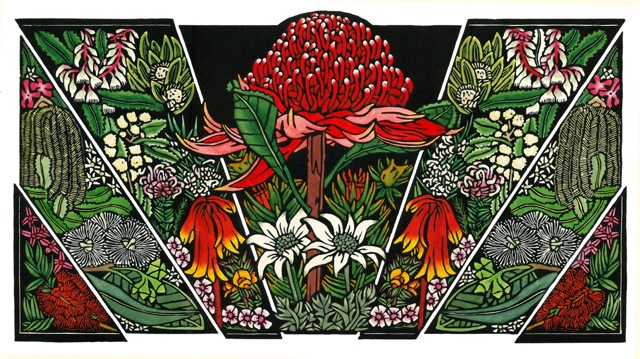
In designing a piece like the DESIGN ART – Emblems – it is quite complex in the amount of visual material I am wanting to include within the overall design. This means it will be overall quite a ‘busy’ design unlike the DESIGN ART Waratah which is a simple single graphic image relying on this for visual impact.

However in creating the overall design for the Emblems I needed to bring some sort of order to the ‘busyness’. I have done this by providing the top central waratah echoed by the Sturt desert pea below. The golden wattle flowers/leaves and kangaroo paw provide framing and visual movement around the design with the Tasmanian gum blossom leaves stabilising the image at the bottom. The other plants of heath (at top either side of waratah), Sturt desert rose on right and Cooktown orchid on left are all pink shaded flowers and seem natural to provide a circular movement  around the work.

Whilst drawing all of this into a design I can revise the overall and minor details of the plan as I go along. This includes spending often large amounts of time ‘art-thinking’ visually assessing over and over what I am doing and where I am placing the elements within the design. I stick photocopies of the images on the walls – even in the bedroom so I can look at when I first wake up. Often I do nothing but look at the progress, source material, or framework and do nothing – it is all in this process of creative ‘art-thinking’. This includes the inking in of the design – again it is returning to this visual head space where I don’t like to be interrupted – it is like switching my brain into another space. It can be frustrating when I cannot get into this zone and things just don’t work – best to go and do something different. Equally it can be extremely frustrating to have this background zone sitting there with ideas and not the time to actually get it happening!

‘ART-THINKING’ VS ‘DOING’ OR USING BOTH!

Not everyone understands the process of stepping back and thinking through things – of sorting through ideas, images, assessing, re-assessing and thinking of alternatives and possibilities. Many people are ‘doers’ and impulsive and many artists work this way and create amazing works. I work more spontaneously in the initial stages of thumbnail sketches but then I get tend to move into this more detailed way of working. Funny my house can be disorganised, messy and spontaneous but my artwork processes are often detailed organised and ordered.

Copyright – Lynette Weir

, , , , , ,

Leave a Comment

Designing linocuts…inside the process…

Designing linocuts or any artwork can be a very individual process depending on many factors including the nature of the artist and the media they work in, the style of work and can even come down to the space/time available.

Many artists work in a highly intuitive and spontaneous manner, particularly in the contemporary arts practice and produce the most wonderful inspirational work.

Other artists spend a long time researching background information, drawing individual aspects of the design or idea, sampling colours and producing smaller works either in total or parts of the final artwork. This method has been a time-honoured tradition so that we have artists workbooks/journals/sketchbooks from great artists like Leonardo Da Vinci – it is through these that we can get a better sense of what the artist was thinking and how they went about producing their artworks.

It is interesting that in art education in high schools now the “journal” or process is an integral part of the curriculum with students needing to show how they came to the end product – their artwork. The NSW HSC requires the use of the “artist journal” as part of the marking and assessment processes.

Copyright – Lynette Weir

, ,

Leave a Comment

Designing a linocut – the process of one design – Part 1

I thought I would work through the process I have used to design the Banksia serrata – Old Man Banksia linocut and the process of its development.

Over some time I had been looking at banksias and in particular Banksia serrata in my garden outside my studio window. I have been photographing this plant for a while but also looking at design ideas on small scraps of paper etc. I have used Banksia serrata – Saw Banksia previously for a linocut but this was a very long time ago. I also completed an illustration and after working from the plant and then photographs I did a drawing of one of the Banksia serrata flowers with their lovely serrated leaves. I love the sweep of leaves down and across.

The thought – ‘this might make s nice linocut’ occurred to me so photocopied the drawing, so I inked in the black areas for the design

‘Mmmmmm…a bit lonely by itself and I REALLY like the Banksia serrata seed pods…and there’s those lovely serrated leaves again…’

‘Perhaps I should look at adding to the DESIGNART series‘ with something a bit different – Banksia serrata, seed pod and leaves.

So I started back with my live plant, a dried seed pod, numerous photos, a new template in the DESIGNART range, and a starting point of my one banksia.

…Part 2 coming next…

Copyright – Lynette Weir

Leave a Comment

Designing a linocut – the process of one design – Part 2

After working through design ideas using a number of photocopies cut up and moving them around and then adding them lightly over the template (size/shape of the basic linocut from the DESIGNART series) I settled on the seedpod over to the right of the template and spilling off. It needed something else so after consulting my plant and photos I decided to add a more ‘ragged’ representation of the flower head after it has opened and is starting to head towards fading from its robust bloom into the ‘softer’ and then wilted phase leading to the seedpods. This is the added on drawing I came up with.

I struggled with the ‘joining’ of the original drawing and the new section – especially as I worked not from the original drawing but the b&w design phase. Trying to get the leaves ‘just right’ was frustrating. Here is one of the images from my plant that I used where you can see all those new growth leaves all falling out over each other.

Eventually I have ended up with 2 images that I have been  ‘sitting  with’ and deciding which one I will use or which combination I may adjust. I will post more when I  start carving. I have actually made a decision.

It is a bit like a game of ‘spot the difference’ – note to self : printmakers and artists can be horribly pedantic!

Just wondering as an exercise for those inclined to design – what would you do?

Copyright – Lynette Weir

, , , , ,

Leave a Comment

Designing a linocut – the process of one design – Part 3

They say sometimes what goes around comes around.

Or perhaps it should be called in this instance the sometimes ‘obsessive’ nature of artists!!


After spending ages on the original drawing design – inking it up and then deciding to fiddle around with it to make it just that little bit better – I have took it back to the original drawing design!!

Another artist at a workshop I did a few years back said he spent weeks deciding to change the wall colour of his lounge room from a mustard yellow. So after much contemplation, colour charts, mixing etc he repainted the room…and yes it was almost the identical mustard yellow!!

So the design is finished – and yes after a week it is back to the original concept!!

Now for transfer to the lino block, carving, printing and handcolouring – I must admit moving from one process to another actually raises the excitement level. Yes I know a bit boring that at each new step it is seen as ‘exciting’ but I think that is why I like the art processes that I am currently working in and keep coming back to them! I do actually really enjoy each step and it provides interest and hopefully challenge. Even if I sometimes end up back where I started!

Copyright – Lynette Weir

, , , , , ,

Leave a Comment

Designing a new linocut…and the use of photcopies and computers…

This is a design based around waratahs…we have 2 quite large local plants which flower really well each spring/summer. One is a roadside planting – mind you the people who live there wondered what this odd person was doing drawing and photographing the waratah – had to explain myself yet again! One of the funniest things was doing a similar thing outside a local farm with the farmer coming to check out what I was doing – “just drawing and photographing the scotch thistles (a weed here!), do you mind if I pick some them from your property?” was greeted with laughter indicating their great amusement at this weird fascination with a weed! She walked away shaking her head…

In designing a larger piece like this I thought I’d give a little insight into the beginnings of the process.

It started with a scrappy little sketch on the back of the only piece of paper I could dig out of the bottom of my handbag one day. I had an idea and just had to get the basics down on paper. Progressing on from there I have been researching, photographing, drawing up and developing different aspects of the original sketch.

This is the original drawing I did based on my research of waratahs, photographs and originals thumbnail concept that involved ideas such as the use of patternwork with leaves and waratah stigma/style, black and white sections vs colour…

I then photocopied this original drawing and using black permanent markers ‘ink’ in the design as a template for carving. It is at this ‘inking in’ stage that I may also adjust the design and use of black vs white areas. I often re-photocopy, cut up sections, glue on extra areas on or use liquid paper to white out areas. Eventually when I am happy with the final design I will photocopy the design one last time and this becomes the final template I use and transfer to the linoblock for carving.

Above is the final blocked in B&W design.

Another tool in designing process can be the computer – you can scan in parts and using photoshop (or something similar) move bits around and try out ideas. An example of this is the use of photoshop to get an idea of the colour tonal values in this new ‘Waratahs’ design. Basically the central waratah will be deep rich colour and the outside leaves will be pale washes of colour – I think they would be paler than here and not this particular green (basically hate both the greens in this photoshopped version but as I said they are only about the tonal values)! The ‘background’ central flower is black and white patternwork essentially. Although the colours I’ve used in the colour image shown here are really nothing like how it will look – the idea of the deep red/green tone and the pale tones helps me in looking at adjustments I may consider or make in the design. Another method is to photocopy a number of copies – even different sizes and cut them up and work with them to experiment with the design.

I try to take some time ‘thinking’ about the designs – though as in the case of this design sometimes I leave or get deadlines that make this hard which can be frustrating. Whilst watching the Rolf Harris portrait series on the ABC I noted there was made mention by the artists of the ‘thinking time’ in working on artworks. Not too long on this one though as I need to get carving the lino as soon as possible…

Copyright – Lynette Weir

, , , , ,

Leave a Comment

Follow

Get every new post delivered to your Inbox.

Join 102 other followers